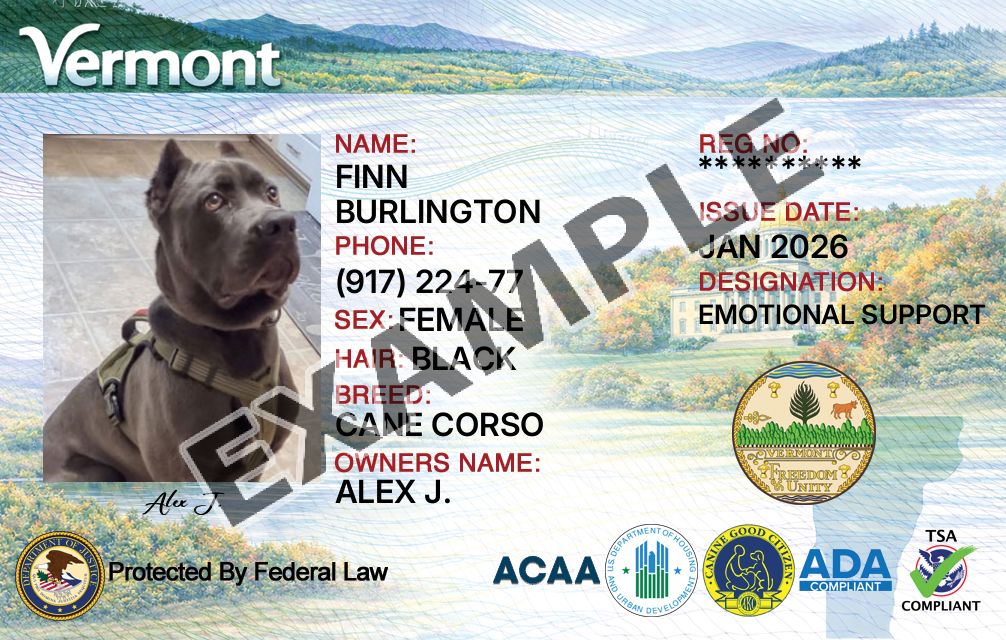
Where Do I Register My Dog in Caledonia County, Vermont for My Service Dog or Emotional Support Dog?
If you’re searching for where to register a dog in Caledonia County, Vermont, the most important thing to know is that a dog license in Caledonia County, Vermont is typically handled by the town where you live—not by a single countywide office. In other words, “Caledonia County” is the region, but dog licensing is municipal in Vermont: you generally license your dog through your local Town Clerk (and in some towns, a Treasurer/Clerk office).
This page explains how local licensing works, the typical rabies vaccination documentation you’ll need, and the key legal differences between a dog license, a service dog, and an emotional support animal (ESA)—so you can confidently take the right next step.
Where to Register or License Your Dog in Caledonia County, Vermont
Because licensing is handled locally, below are example official offices within Caledonia County, Vermont that publish dog licensing and/or animal control information. If your town is not listed here, your best starting point is your own town’s clerk office (or town website) for “Dog Licensing.”
Town of St. Johnsbury — Town Clerk & Treasurer
Address
51 Depot Square, Suite 101
St. Johnsbury, VT 05819
Phone
802-748-4331 ext. 1
townclerk@stjvt.com
Notes
- Dog licensing information is published by the town.
- Licensing is required in the town where you reside.
- Bring a current rabies certificate when licensing.
Town of Lyndon — Town & Village Clerk’s Office
Street Address
119 Park Avenue
Lyndonville, VT 05851
Phone
802-626-5785
Office Hours
Monday–Friday, 7:30 AM–4:30 PM
Town of Barnet — Town Clerk’s Office
Street Address
William E. Hoar Town Hall
154 Church Street
Barnet, VT 05821
Phone
802-633-2256
townclerk@barnetvt.org
Office Hours
Weekdays 9:00 AM–12:00 PM, 1:00 PM–4:30 PM
Overview of Dog Licensing in Caledonia County, Vermont
Dog licensing is usually handled by your town (not the county)
In Caledonia County, Vermont, you typically do not “register at the county level.” Instead, you get a municipal license in the town where you reside. That’s why searches like animal control dog license Caledonia County, Vermont often lead you to a town clerk or town animal control page: your local town office is the primary licensing authority.
Many towns administer dog licensing through the Town Clerk (or combined Clerk/Treasurer office). Some towns also publish a separate Animal Control Officer contact for enforcement and complaints, while the clerk’s office handles the actual license issuance and renewal.
Annual deadline and age threshold
Vermont towns commonly require licensing for dogs over a certain age and set an annual deadline. For example, the Town of St. Johnsbury states that dogs are required to be licensed by April 1 in the town in which you reside, and that you can register your dog by visiting the Town Clerk’s Office during business hours. The same town also notes that dogs over 6 months are required by state law to be licensed before April 1 each year. (Local fees and late fees can vary by town.)
Rabies documentation is central to licensing
Proof of a current rabies vaccination is commonly required to obtain or renew a license. St. Johnsbury’s clerk information specifically states that you must have a current rabies certificate to license a dog and describes timeframes that depend on the dog’s age. Separate municipal guidance from other Vermont towns similarly explains that proof of up-to-date rabies vaccination is required for licensing, reflecting broader statewide practice.
How Dog Licensing Works Locally in Caledonia County, Vermont
Step 1: Identify the correct town office for your address
The correct place to start is the town where your dog primarily lives (your legal residence). That town’s clerk office is usually the “front counter” for licensing. This is why the best answer to where to register a dog in Caledonia County, Vermont is often: “At your town clerk’s office.” If you recently moved, check your new town’s website for “Dog Licensing” instructions or call the clerk office to confirm the process.
Step 2: Gather required documentation (especially rabies proof)
Most towns will ask for a rabies vaccination certificate signed by your veterinarian. Some clerk offices specify that the certificate must be current and may note vaccination windows by age (for example, different intervals for younger vs. older dogs). Bring any other identifying details the town requests (such as the dog’s description, breed, sex, color, and whether the dog is spayed/neutered if relevant to fee schedules).
Step 3: Apply in person or by mail (varies by town)
Each municipality can set its own practical workflow. Some towns emphasize in-person licensing at the clerk’s office; others allow mail-in licensing when you include the rabies certificate and payment. For example, the Town of Barnet describes licensing as due annually and notes options to purchase by mail or at the Town Clerk’s Office during weekday hours.
Step 4: Receive your license/tag and keep it current
Once issued, your dog’s municipal license typically includes a tag or number associated with that annual license. Keep your documentation accessible—especially if your dog is found at large, if there’s an animal control inquiry, or if you need to show proof of compliance for housing or travel. Renew annually and update vaccination records as needed.
Service Dog Laws in Caledonia County, Vermont
A dog license is not the same as “service dog registration”
A common point of confusion is thinking you must “register” a service dog with the county or state to make it official. In practice, a municipal dog license is a local requirement for dogs living in a town. A service dog’s legal status, however, is based on disability-related laws and the dog’s training to perform tasks for a person with a disability—not on a special license category from the town.
Put simply: you may need a municipal dog license even if your dog is a service dog, because licensing is about local animal/rabies compliance and identification. The service dog status is about public access and accommodation rights under applicable disability laws.
Service dogs are trained to perform tasks
A service dog is generally understood as a dog trained to perform specific tasks or work directly related to a person’s disability (for example, guiding, alerting, retrieving, interrupting harmful behaviors, or providing mobility assistance). Training and function are what matter—there isn’t a single official “county service dog registry” you must use to make it legitimate.
What local offices typically can (and cannot) do
Town clerk offices in Caledonia County generally can issue a dog license and advise what documentation they require (rabies certificate, fees, deadlines). They usually do not “certify” service dogs or issue special federal-style service dog credentials. If a local form asks for a dog description or special notes, that is for municipal records—not a determination of service dog legal status.
Emotional Support Animal Rules in Caledonia County, Vermont
An ESA is not a service dog
An emotional support animal (ESA) provides comfort by its presence, but an ESA is not the same as a service dog trained to perform tasks. This difference matters for public access: ESAs are not automatically allowed everywhere the way service dogs are.
You still typically need a municipal dog license
If your ESA is a dog living with you in a town within Caledonia County, you usually still need to comply with local licensing rules and rabies vaccination requirements. The town’s licensing process is separate from any housing accommodation process you may pursue for an ESA.
Avoid “ESA registration” confusion
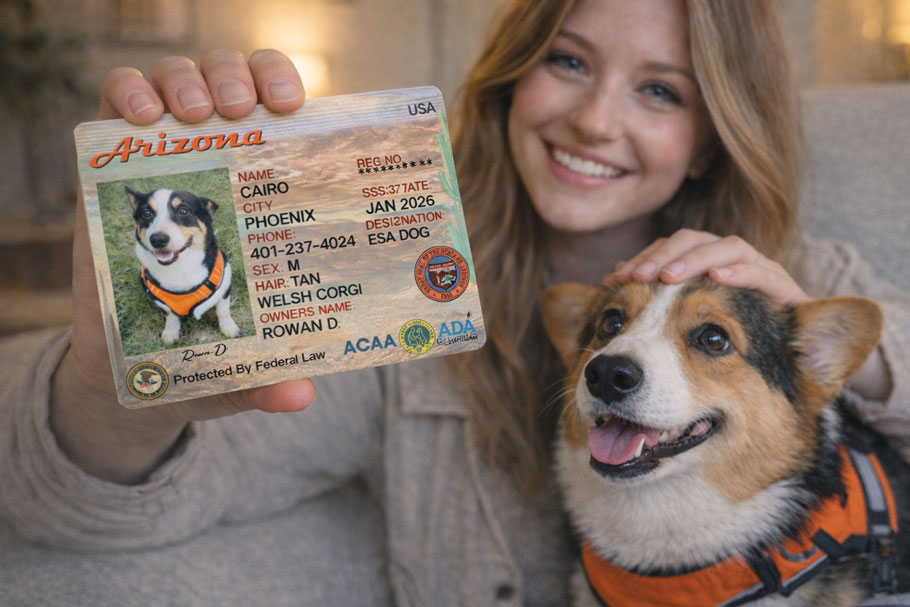
Many people search for “registration” when they really mean one of two things: (1) the local municipal dog license, or (2) documentation for housing accommodations. A municipal clerk’s dog license is an official local record. By contrast, paid “ESA registries” are not the same thing as municipal licensing and are not required by Vermont towns for dog licensing.
Frequently Asked Questions
- Dog license: A local (town) record showing your dog is licensed and typically tied to rabies vaccination compliance.
- Service dog: A dog trained to perform tasks for a person with a disability; status is based on training and function, not a town “registration.”
- ESA: An animal that provides emotional comfort by presence; generally not the same public-access status as a trained service dog.
Still not sure where to go?
If you’re still asking where do I register my dog in Caledonia County, Vermont for my service dog or emotional support dog, the practical answer is: start with your town clerk’s office in the town where you live. If your town uses an animal control officer for enforcement questions, the clerk’s office can typically point you to the correct contact for local “animal control dog license Caledonia County, Vermont” issues like stray dogs, tags, or complaints.